
Can AI Design My Home? An Interior Designer's Honest Answer
The short answer, yes. And no.
Yes, AI can help you decorate your home. It's a genuinely fun brainstorming buddy for picturing a new paint color, a different sofa, or a freshly styled bookshelf.
What it can't do is tell you whether that idea will actually work in your house. AI images are often inaccurate, the measurements are rarely right, and the ideas aren't always good ones. Knowing the difference still takes judgment. Ideally, a designer's.

Where AI actually earns its keep
Let's give credit where it's due. Used well, AI image tools are great at helping you see a possibility before you spend a dime on it.
Paint color previews. Snap a photo of your dining room and ask to see it in a deep green. It's a quick gut check before you buy a single sample pot.
Trying on furniture. Wondering if a curved sofa or a round coffee table changes the vibe? AI can mock it up in seconds.
Small styling moments. Bookshelves, a console table, a nightstand vignette. AI is surprisingly decent at showing how to layer books, objects, and greenery.
Useful for a first impression, as long as you remember it occasionally adds a third sleeve.
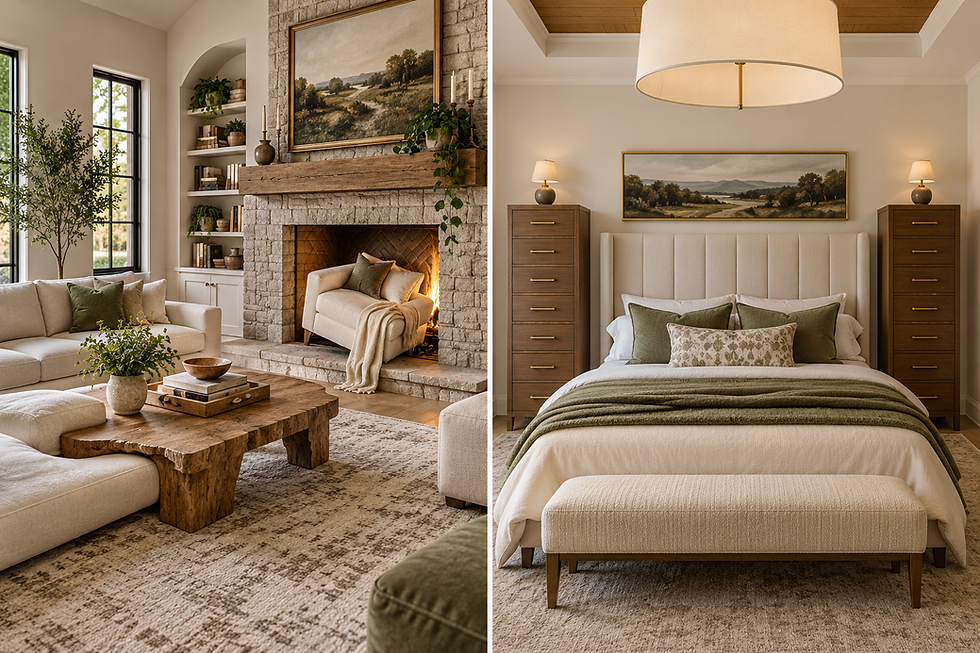
Where AI falls apart: it doesn't know how houses work
If you've played with these tools, you've seen the head-scratchers. A toilet inside the shower. A window that wasn't there yesterday. A door that leads to... nowhere, actually.
This isn't a glitch you can prompt your way out of. As one real estate brokerage put it, AI knows how homes are supposed to look, not how they're actually built. That's why it invents doorways to nowhere, tilted windows, and baseboards that change height mid-wall. https://urbanacres.com/how-to-spot-ai-in-real-estate/
Measurements are the other big miss. Even a company that sells AI virtual staging admits these tools place furniture by visual pattern, not real room dimensions. Hello, sectional that swallows two-thirds of the living room. https://www.photoup.net/learn/ai-virtual-staging-mistakes-that-can-hurt-your-listing
The research backs this up. When university and Microsoft researchers tested image generators on simple placement instructions (this object next to that one), even the best model got the arrangement right less than 40% of the time. Newer models are better, but a 2026 benchmark found they still often fail at complex spatial relationships. https://arxiv.org/html/2601.20354v1
So yes, you got an idea. But an idea you can't measure, buy, or build isn't a plan. It's a pretty picture.

Pretty isn't the same as right
Here's the part nobody talks about: AI doesn't invent new ideas. It remixes the ones it has already seen.
Image generators learn from millions of pictures pulled from the internet. Researchers have caught popular models copying straight from that training data. And when a late-2025 study in the journal Patterns let image AI riff on itself for 100 rounds, nearly every run drifted toward the same dozen generic scenes, palatial interiors included. The researchers' name for it: "visual elevator music."
It's not just pictures. In a Science Advances study, writers who got story ideas from AI turned in work that was rated more creative, but their stories were more alike. Individually better, collectively more same-y. Sound familiar? It's every "modern organic" living room on your feed.
Now apply that to your house. AI doesn't know you're keeping the honey oak trim, or that your kitchen has cherry cabinets and a busy granite. It might hand you a gorgeous moody living room that looks amazing on its own and awful next to the kitchen you can see from the sofa. Even that AI staging company notes its tools default to what's trending, not what suits the home's architecture.
It can style a shelf. It can't lay out a room.
Small, contained tasks? Go for it. Ask AI how to style a bookshelf and you'll probably get something useful.
Furniture layout is a different animal. A good layout is about how you actually live: where people walk, where the TV glare hits at 4 p.m. in January, where the dog sleeps, where the backpacks land. AI doesn't see traffic patterns or how your family uses a room. It sees a picture that looks like other pictures.
More ideas won't get you unstuck
Here's the irony: the thing people hope AI will fix is the thing it often makes worse. Most of us aren't stuck because we're short on ideas. We're stuck because we can't decide.
AI will cheerfully hand you 50 more living rooms. Each one raises a new "but what about...?" and chips away at the confidence you walked in with. More options rarely bring clarity. Usually they just bring more second-guessing.
What actually gets you unstuck is a decision, made with someone who can tell you why it's the right one. That's judgment, and it doesn't come from a prompt.
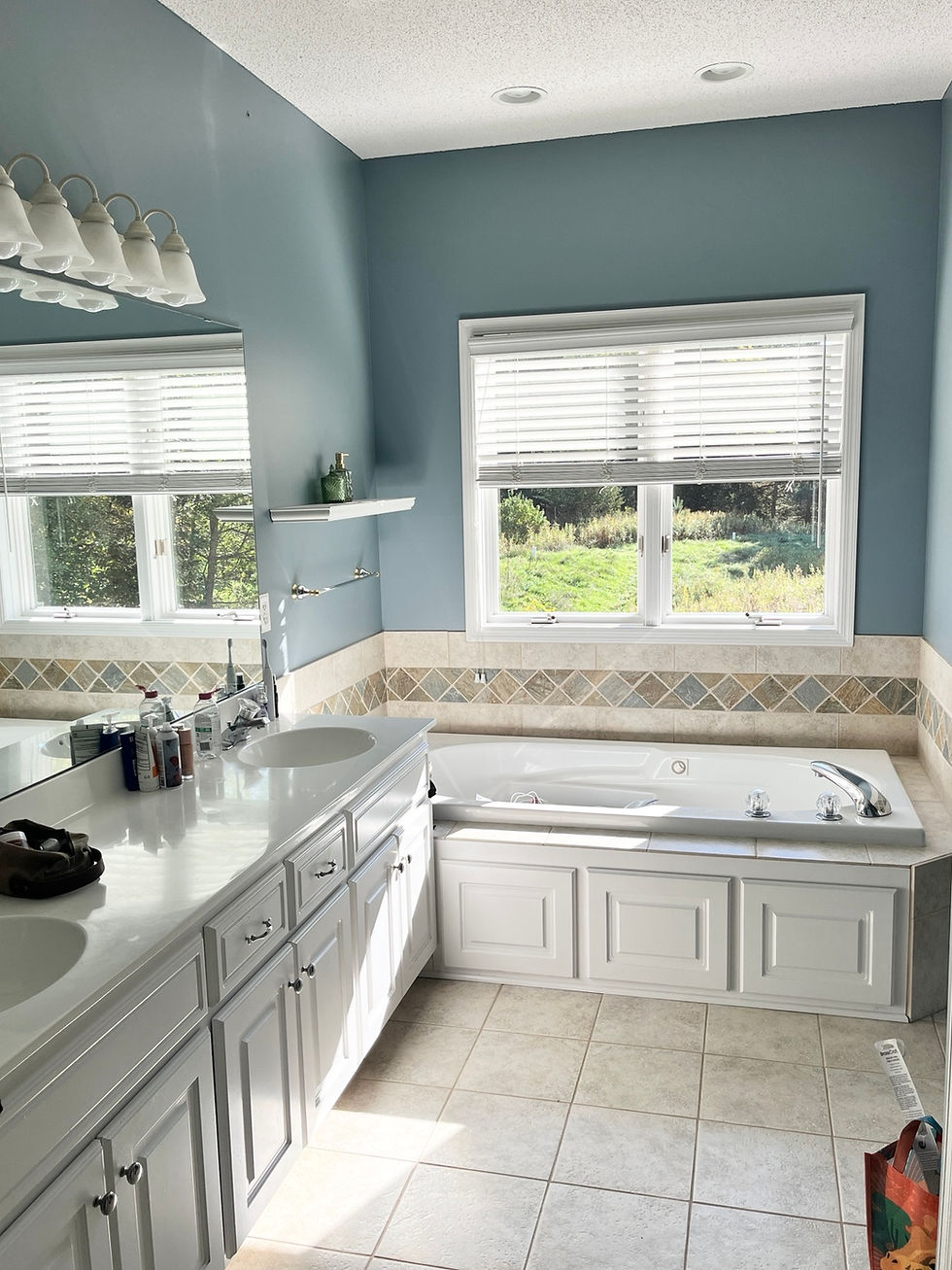

What a designer brings that AI can't
AI has seen a million living rooms. A designer has stood in yours.
Design Expertise. Knowing which of 40 pretty ideas actually fits your home, your budget, and your life, and being honest about the ones that don't.
Whole-house thinking. Your living room has to talk to your kitchen, your entry, and the hallway in between. We design for the view from the sofa, not just the view in the frame.
Respect for what's staying. Flooring, trim, fireplaces, countertops, and cabinetry are the starting point, not an afterthought.
Real measurements and real furniture. Pieces you can actually order, in sizes that fit, with room to walk around the coffee table.
Creativity and thoughtfulness. Having a unique space that speaks directlytyou and your lifestyle cannot come from AI, as it doesn't come up with new ideas. So if you don't want to look like everything else out there, a designer can bering you a fresh perspective based on true design principles.
We're not here to take the fun out of it. We're here to make sure the fun ends with a room that works. And you keep the final say.


Plot twist: I use AI too
Don't get me wrong. I'm not anti-AI. As a designer, I love using it to illustrate the ideas I can already see in my head.
For a consultation-based design firm like ours, it's a fantastic tool. When I tell a client that a sectional right here, in her favorite red, would look amazing, that's one thing. When I can show her, she gets it in seconds.
Same with the client who wanted green kitchen cabinets but also didn't know what color countertops and backsplash to use, and had no idea that her microwave shouldn't be above her stove. With AI, I could show her exactly what her finished kitchen would look like, before anyone picked up a paintbrush.
The difference? I'm directing AI. AI shows the idea, and my judgment decides whether it's the right idea. Here are a few ways I've used it in real consultations.

How to use AI the smart way
AI makes a great sketchbook. Here's how to keep it there.
Use it for ideas, not decisions. Save the images you love and jot down why: the color, the texture, the mood.
Start from a photo of your real room. Edits to your actual space beat fantasy rooms, and they make the weird stuff easier to spot.
Check for the impossible. Count the doors and windows. Look for floating furniture and fixtures in strange places.
Never buy from a rendering. Measure the room and the piece. Then measure again.
Ready for a second set of eyes?
Keep your AI images. Just don't let them make the final call. Here are two ways to get real design help, whether you love to DIY or you're ready to hand it off.
Join the Happy Place Design Club. Choose from three plans, starting at just $9 a month. Every plan includes our online library of design lessons and resources. Step up for monthly live Q&A sessions where you can ask a designer about your own space, or go VIP for one-on-one support on your project.
Book a design consultation. We come to you in Minneapolis, St. Paul, and across the Twin Cities metro, or meet virtually anywhere in the U.S. Bring your photos, your measurements, and yes, your AI screenshots. We'll help you figure out which ideas are worth keeping.

Melanie Zaelich is the owner and lead designer at Happy Place Interiors, located in Minneapolis, MN. Follow on Instagram at https://www.instagram.com/happy.place.interiors/
Visit the website: https://www.happyplaceinteriors.com
Quick answers
Can AI replace an interior designer?
No. AI can generate inspiration images, but it can't measure your space, judge whether an idea fits your home's architecture and finishes, or plan a layout around how you actually live.
What's the best way to use AI for home decorating?
Start with a photo of your real room and use AI to explore colors, styles, and furniture shapes. Treat the results as inspiration, then check measurements and fit before you buy anything.
Why do AI room designs look so wrong sometimes?
Image generators predict what a room should look like based on other pictures. They don't understand construction or dimensions, so they invent doors and windows, misplace fixtures, and get furniture scale wrong.
Sources
Gokhale et al., Benchmarking Spatial Relationships in Text-to-Image Generation, arXiv
Everything in Its Place: Benchmarking Spatial Intelligence of Text-to-Image Models, arXiv, 2026
Somepalli et al., Diffusion Art or Digital Forgery? Investigating Data Replication in Diffusion Models, CVPR 2023
Hintze et al., Autonomous language-image generation loops converge to generic visual motifs, Patterns, 2025
Doshi and Hauser, Generative AI enhances individual creativity but reduces the collective diversity of novel content, Science Advances, 2024
Urban Acres Real Estate, How to Spot AI in Real Estate, January 2026
PhotoUp, AI Virtual Staging Mistakes That Can Hurt Your Listing, June 2026
Comments